Choosing reliable Drip Connectors can determine whether an irrigation system performs smoothly or leaks under pressure. For global buyers, the decision involves more than factory price. Connector geometry, material quality, sealing performance, and production consistency all deserve close inspection.
Dr. Daniel Hillel, a respected irrigation scientist, wrote, “Irrigation is the artificial application of water to the soil.” His principle remains practical today. Drip Connectors must deliver water accurately, without wasting pressure or damaging fragile tubing. A small crack can affect an entire greenhouse row. That detail is easy to overlook.
This guide introduces China’s top ten Drip Connectors manufacturers for international buyers. It considers product range, manufacturing experience, export capability, quality control, and technical support. It also examines thread standards, barb dimensions, UV resistance, and compatibility with polyethylene pipes. These factors matter during installation and long-term field use.
The ranking is not absolute. No supplier fits every project. Some manufacturers offer excellent custom molding but limited documentation. Others provide strong testing records but higher minimum order quantities. Buyers should request samples, drawings, material declarations, and pressure-test results before placing large orders.
Factory visits can reveal useful details. Check mold maintenance, assembly lines, leak testing, and packaging protection. Ask how rejected parts are recorded. Ask again when answers seem vague. Reliable suppliers usually welcome technical questions and provide traceable information.
Prices fluctuate. Quality should not. This overview aims to support careful comparison, practical sourcing, and better irrigation decisions. Mistakes still happen, but disciplined evaluation reduces costly surprises.
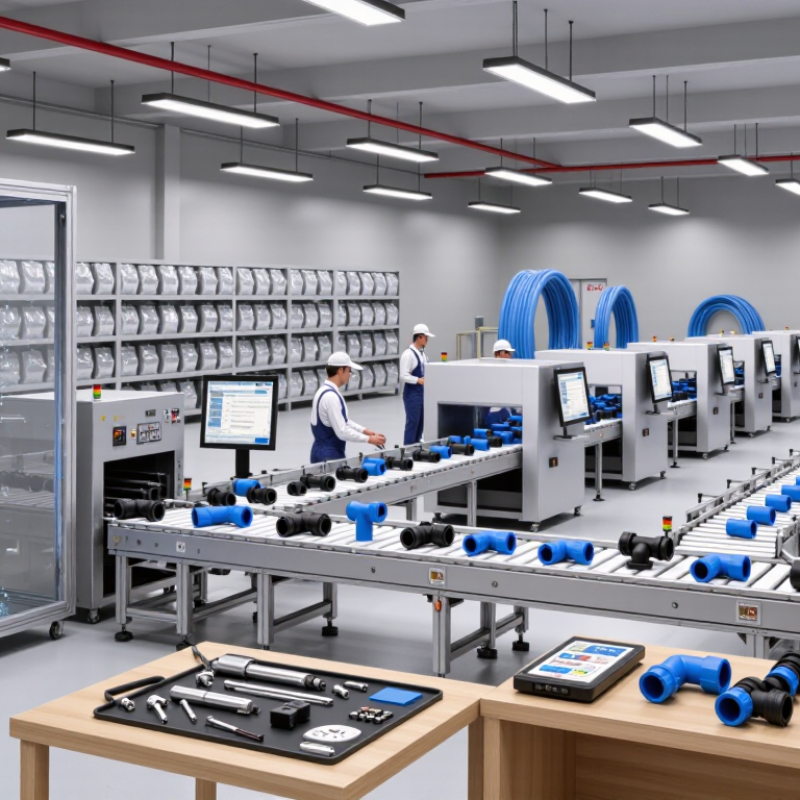
When evaluating China’s top drip connector manufacturers, global buyers should classify products by tubing standards first. The 16 mm, 20 mm, and 25 mm categories are not interchangeable. A connector may look suitable, yet leak after pressure rises.
Sixteen-millimeter connectors are widely used for lateral drip lines and greenhouse rows. They suit compact beds, nursery containers, and low-to-medium flow zones. Buyers should check the tube’s outside diameter, wall thickness, and connector barb size. A tight fit matters. For 20 mm tubing, connectors usually support longer runs and higher discharge demands. They are useful for vegetable fields, orchards, and larger greenhouse sections. Locking rings can improve stability where temperature changes soften the tubing.
Twenty-five-millimeter connectors are better suited to distribution lines and larger irrigation blocks. Their wider passage can reduce friction loss across extended layouts. However, a larger connector does not automatically improve the whole system. Filters, valves, pumps, and pressure regulators must match the intended flow. That detail is often missed.
Experienced buyers should request dimensional drawings, material specifications, pressure-test records, and sample fittings before placing volume orders. Factory quality can vary between production batches. This deserves attention. Field testing should include repeated connection and disconnection, sunlight exposure, and several pressure cycles. Nominal sizing also needs confirmation, because regional tubing standards may differ slightly. A neat catalog chart can still mislead. The practical choice depends on measured tubing dimensions, operating pressure, water quality, and installation conditions.
Anonymous product-category comparison based on commonly used agricultural irrigation connector specifications
| No. | Anonymous Manufacturer Profile | Primary Tubing Standard | Typical Connector Range | Common Connector Types | Typical Material | Connection Method | Common Application | Buyer Verification Point |
|---|---|---|---|---|---|---|---|---|
| 1 | Profile A — 16 mm Dripline Specialist | 16 mm | 16 mm take-off, joiner, elbow, tee, end cap | Barbed connectors, repair couplers, start connectors | UV-stabilized PP or acetal/POM | Barbed push-fit; optional locking nut | Vegetable beds, orchards, greenhouse rows | Confirm actual outside diameter and dripline wall thickness |
| 2 | Profile B — 16 mm Pressure-Compensating System | 16 mm | 16 mm inline and take-off fittings | Start connector, valve connector, flush valve, tee | UV-stabilized polypropylene | Barbed or threaded take-off connection | Long rows and uneven terrain irrigation | Check sealing performance at the intended operating pressure |
| 3 | Profile C — 16 mm Multi-Season Connector Range | 16 mm | Straight coupler, cross, tee, elbow and end closure | Reusable repair fittings and locking connectors | Acetal/POM, PP, or engineering polymer blends | Push-fit with external compression ring | Seasonal field crops and removable dripline | Request UV-aging data and repeated assembly test results |
| 4 | Profile D — 20 mm Mainline Transition Range | 20 mm | 20 mm coupler, tee, elbow and line-start connector | Mainline fittings, take-off adapters and shut-off valves | UV-stabilized PP or POM | Barbed, compression or threaded adapter | Small farm blocks and greenhouse distribution lines | Verify whether 20 mm refers to nominal size or measured outside diameter |
| 5 | Profile E — 20 mm Filter and Valve Integration Range | 20 mm | 20 mm inlet and outlet adapters | Filter adapters, pressure-regulator connectors and valves | Reinforced PP or glass-filled nylon for selected parts | Threaded connection with gasket or O-ring | Drip irrigation submain and fertigation systems | Confirm thread profile, gasket material and flow direction |
| 6 | Profile F — 20 mm Commercial Row-Irrigation Range | 20 mm | Heavy-duty coupler, tee, elbow, cross and flush end | Compression fittings and reinforced barbed connectors | High-impact PP or acetal/POM | Compression nut or locking barb | Open-field crops and commercial nurseries | Match fitting dimensions with the exact pipe wall and hardness |
| 7 | Profile G — 25 mm Distribution-Line Range | 25 mm | 25 mm coupler, tee, elbow and valve connector | Mainline fittings, manifolds and take-off adapters | UV-stabilized PP or reinforced polymer | Compression, barbed or threaded connection | Larger greenhouse zones and agricultural submains | Check whether the system uses 25 mm OD tubing or a nominal pipe size |
| 8 | Profile H — 25 mm High-Flow Connector Range | 25 mm | High-flow coupler, tee, cross and isolation valve | Compression fittings and manifold connectors | Glass-filled nylon or reinforced polypropylene | Threaded or compression connection with O-ring | High-flow distribution before drip laterals | Request flow-loss data and pressure-test results for the complete assembly |
| 9 | Profile I — 16/20/25 mm Transition Range | 16, 20 and 25 mm | Step-down adapters, reducers, tees and end connections | Reducing connectors and mixed-size manifold fittings | UV-stabilized PP, POM or reinforced nylon | Barbed-to-threaded or compression transition | Systems combining submains with smaller drip laterals | Confirm both connection diameters and compatibility of sealing surfaces |
| 10 | Profile J — Export-Oriented Mixed-Standard Range | 16, 20 and 25 mm | Complete connector assortment with optional threaded adapters | Couplers, elbows, tees, valves, end caps and take-offs | UV-stabilized PP, POM and reinforced nylon components | Barbed, compression and BSP/NPT adapter options | International projects requiring mixed regional standards | Confirm thread standard, dimensional tolerances, packaging and export documentation |
Compare monthly capacity, MOQ, customization, communication, and documented export experience. A large factory is not always the best fit.
Large producers may require 50,000 pieces or more. Mid-sized factories may accept around 10,000 pieces. Smaller workshops can offer lower quantities, but production depth may be limited.
PP offers chemical resistance and lower cost. POM can provide stronger threads and better dimensional stability. Reinforced nylon may suit higher pressure, but UV performance needs checking.
Request five production samples instead of one attractive sample. Measure barb diameter, wall thickness, insertion force, and leakage. Test every sample under identical pressure.
Request current test reports, traceability records, and material specifications. Confirm that certificates match the actual manufacturing site. ISO 9001 supports process control, but it does not prove irrigation performance.
Standard orders often require 15–30 days. Custom molds can add several weeks. Confirm sample timing and mass-production timing separately. Leave buffer time.
Calculate the delivered cost per 1,000 units. Include packaging, freight, installation, and expected replacement losses. A low quotation may become expensive when five percent of connectors leak.
Install identical lines with a pressure gauge. Compare leakage and flow from the first outlet to the last. Test during temperature changes, fertilizer exposure, and routine line movement. Connector design alone cannot fix dirty water or excessive pressure.
Ask about coverage duration, replacement procedures, and installation exclusions. A 12–24 month warranty is common. Response quality matters more than duration. Some promises change later.
This guide provides global buyers with a practical framework for evaluating China’s top 10 Drip Connectors manufacturers. It classifies connectors according to 16 mm, 20 mm, and 25 mm tubing standards, while explaining how to verify ISO 9261 compliance, operating pressures from 0.5 to 4 bar, and flow rates between 2 and 8 L/h. The comparison focuses on production capacity, minimum order quantities, export markets, certifications, material grades, lead times, and warranty terms.
Buyers will also learn how to compare the total cost per 1,000 units with expected service life and water-saving performance. By reviewing connector compatibility, sealing reliability, pressure stability, and supplier support, purchasers can identify solutions suited to different irrigation projects and budgets. The goal is to support informed, efficient, and durable procurement decisions without relying solely on price.

 Minde